

Working Principle of Flameproof Enclosures: How They Prevent Explosions in Hazardous Industries
- Shreeelectrical
Introduction
In hazardous industrial environments, where flammable gases, vapors, or combustible dust are present, electrical equipment can become a potential source of ignition. Industries such as oil & gas, petrochemicals, chemical processing, pharmaceuticals, mining, paint manufacturing, food processing, and offshore facilities require specialized electrical equipment designed to eliminate explosion risks.
One of the most effective solutions is the flameproof enclosure. Unlike ordinary electrical enclosures, flameproof enclosures are specifically engineered to contain an internal explosion and prevent it from igniting the surrounding hazardous atmosphere.
Understanding the working principle of flameproof enclosures is essential for plant engineers, safety managers, procurement professionals, and maintenance teams responsible for ensuring operational safety and regulatory compliance.
What Is a Flameproof Enclosure?
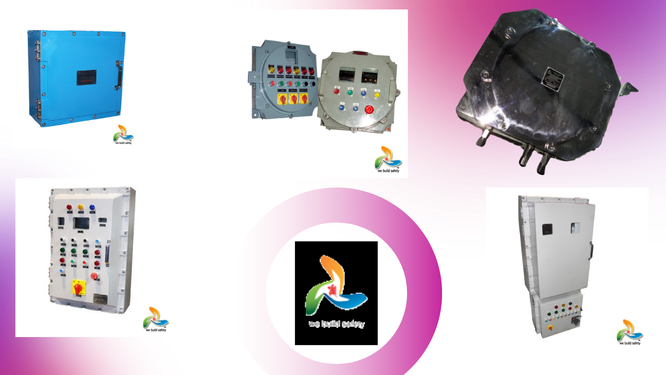
A flameproof enclosure is a robust protective housing designed to safely contain any explosion originating within the enclosure. If an electrical fault generates sparks or excessive heat that ignites the explosive mixture inside, the enclosure prevents the flame from escaping into the surrounding hazardous area.
Instead of preventing an explosion from occurring inside the equipment, the enclosure is engineered to safely withstand the explosion and stop it from propagating outside.
The Core Philosophy: Containment vs. Prevention
Most hazardous area protection concepts operate on the principle of prevention. For example, Intrinsic Safety (Ex i) limits the electrical and thermal energy of a circuit so that it cannot generate a spark capable of ignition. Increased Safety (Ex e) uses superior structural integrity and strict electrical clearances to ensure sparks never occur under normal or abnormal conditions.
Flameproof (Ex d) engineering takes the opposite approach. It accepts a foundational premise: flammable gas will eventually penetrate the enclosure, and internal electrical equipment will ignite it.
Instead of trying to stop the ignition from happening internally, an Ex d enclosure is strictly engineered to accomplish two tasks:
- Withstand the mechanical pressure generated by the internal explosion without cracking, fracturing, or deforming
- Quench the resulting flame front and cool the escaping exhaust gases so that they cannot ignite the hazardous, explosive atmosphere surrounding the outside of the enclosure
Working Principle of Ex d Enclosures
The entire mechanical engineering architecture of a flameproof enclosure hinges on a paradox: the enclosure is not hermetically sealed. Instead, it relies on precisely designed, microscopic mechanical gaps known as Flame Paths.
The Mechanics of an Internal Explosion
When gas enters the enclosure and meets a spark, a localized deflagration occurs. This rapid combustion creates a severe, instantaneous rise in internal pressure (often exceeding 8 to 10 bar gauge depending on the gas group and enclosure volume). The expansion forces the superheated gases, fire, and smoke outward toward the only exit points available: the mechanical joints where the enclosure pieces meet (e.g., the lid, flange, or threaded entries).
- Switching arcs
- Relay sparks
- Contact failures
- Component overheating
- Internal electrical faults
[Internal Spark] ──> [Gas Ignites] ──> [Pressure Spikes (8-10+ Bar)]
│
▼
[Safe External Air] <── [Gases Cooled < Auto-Ignition] <── [Flame Path Quenching]
The Flame Path Function
The flame path is a micro-gap between two mating metal-to-metal surfaces. As the violent, hot combustion gases are driven through this narrow pathway, two physical phenomena happen simultaneously:
- Thermal Quenching (Heat Transfer): The massive, cold metal walls of the enclosure act as a heat sink. As the thin sheet of flame passes through the narrow path, the metal rapidly absorbs its heat energy.
- Expansion Cooling: When the gas finally exits the micro-gap into the outer atmosphere, it experiences a sharp pressure drop, which causes rapid thermodynamic expansion and cooling.
By the time the gas clears the flame path, its temperature has dropped significantly below the Auto-Ignition Temperature (AIT) of the surrounding ambient gas. The flame is physically choked out, and nothing but safe, cooled air enters the hazardous zone.
Critical Engineering Metrics
Flame path geometries are highly regulated by standards like IEC 60079-1. They are governed by two strict mathematical dimensions:
- Flame Path Length (L): The minimum distance the gas must travel across the joint surface.
- Flame Path Gap (W): The maximum permissible clearance width between the two mating faces.
Structural Design and Testing Paradigms
Because the enclosure must absorb the kinetic energy of an explosion without cracking, material selection and structural validation are rigorous.
Material Science Choices
- Cast Copper-Free Aluminum: Widely used for its excellent strength-to-weight ratio and natural resistance to atmospheric corrosion, making it the standard choice for terminal boxes and small motor starters.
- Cast Iron or Carbon Steel: Deployed in ultra-high-volume heavy machinery or mining environments where raw structural rigidity is necessary to endure brutal impact and massive pressure piling.
- 316L Stainless Steel: The gold standard for offshore marine, petrochemical, and coastal facilities due to its superior resistance to chloride-induced pitting and harsh chemical washdowns.
The Pressure Piling Phenomenon
A major challenge in Ex d design is pressure piling. If an enclosure features internal compartments or large components split by narrow gaps, the initial combustion in one pocket compresses the unburned gas mixture into the adjacent pocket before the flame front arrives. This causes the secondary pocket to detonate under pre-compressed conditions, resulting in an exponential pressure spike that can easily rupture poorly designed walls. Engineers utilize finite element analysis (FEA) to ensure free cross-sectional areas and optimized internal volume layout to minimize this risk.
Strict Overpressure Testing
Before an Ex d enclosure can leave the manufacturing floor, it undergoes a mandatory hydrostatic overpressure test. Regulations dictate that enclosures must be structurally tested to a minimum of 1.5 times the maximum reference pressure recorded during dynamic testing, or up to 4 times the pressure for routine type-testing without individual unit batches. The enclosure must exhibit zero permanent deformation, structural micro-fractures, or seal failures to pass.
Key Global Trends Shaping the Flameproof Industry
The flameproof engineering market is undergoing significant transformations driven by digitization, sustainability, and material science innovations.
Dynamic Thermal Management
As digital transformation sweeps through heavy industries, operators are installing complex electronics, variable speed drives (VFDs), and compact PLCs directly into hazardous fields. These high-performance computing components emit considerable heat.
Because Ex d enclosures rely on thick metal walls and lack standard convective ventilation vents, internal thermal management is notoriously difficult. Modern trends include the integration of conductive heat spreaders, advanced phase-change material (PCM) potting, and externally finned heat exchanger profiles designed to rapidly dissipate thermal load while maintaining flamepath absolute integrity.
Smart Enclosures and Predictive Maintenance
Historically, inspecting an Ex d enclosure meant manually micro-measuring flame path gaps with feeler gauges during downtime. Today, the industry is transitioning to "smart enclosures." Embedded IoT sensors monitor internal humidity, cyclic pressure differentials, temperature gradients, and localized corrosion. This real-time telemetry allows plant managers to spot deterioration in flame path tolerances before an unsafe gap or path degradation occurs, shifting operations from reactive checklists to true predictive maintenance schedules.
Harmonization of Global Standards (NEC vs. IECEx)
For decades, a major pain point for engineering procurement teams was the regional discrepancy between North American standards (NEC / UL Class & Division system) and international standards (IECEx / ATEX Zone systems). North America traditionally specified "Explosion-proof" equipment built to withstand up to four times explosion references, while the rest of the world utilized "Flameproof" concepts.
The industry is rapidly converging toward a harmonized global standard. Modern engineering firms are designing dual-certified enclosures that simultaneously satisfy NEC Article 505 zone definitions and standard IEC 60079 series metrics, reducing engineering design friction and unifying spare-parts inventories for multinational operators.
Summary of the Flameproof Lifecycle
[Design Phase] ──> FEA & Material Selection (Cast Alum/316L SS)
│
▼
[Manufacturing] ──> Precision machining of Flame Paths (Ra ≤ 6.3μm)
│
▼
[Certification] ──> Hydrostatic test at 1.5x reference pressure
│
▼
[Operation] ──> Smart IoT sensing + Preventive gap inspection
Conclusion
The working principle of flameproof enclosures is based on one fundamental objective: to safely contain an internal explosion and prevent it from igniting the surrounding hazardous atmosphere. By combining robust construction, precision-engineered flame paths, and internationally recognized certification standards, flameproof enclosures provide a critical layer of protection for industrial plants operating in explosive environments.
As industries continue to adopt automation and smarter technologies, the demand for high-performance flameproof solutions will only increase. Investing in certified flameproof enclosures is not just about meeting regulatory requirements—it is about safeguarding personnel, protecting valuable assets, minimizing downtime, and ensuring uninterrupted industrial operations.
Shree Group of Companies is a trusted manufacturer and supplier of certified flameproof and explosion-protected electrical equipment. Our product portfolio includes flameproof control panels, junction boxes, lighting fixtures, cable glands, push button stations, instrumentation panels, and customized hazardous-area solutions designed to meet ATEX, IECEx, PESO, BIS, and other international standards. Whether your facility operates in oil & gas, petrochemicals, pharmaceuticals, mining, or any other hazardous industry, our engineering expertise helps you achieve the highest standards of safety, performance, and compliance.
Need a customized flameproof solution for your plant? Contact Shree Group of Companies today to discuss your hazardous-area requirements and discover how our certified products can enhance the safety and reliability of your operations.